


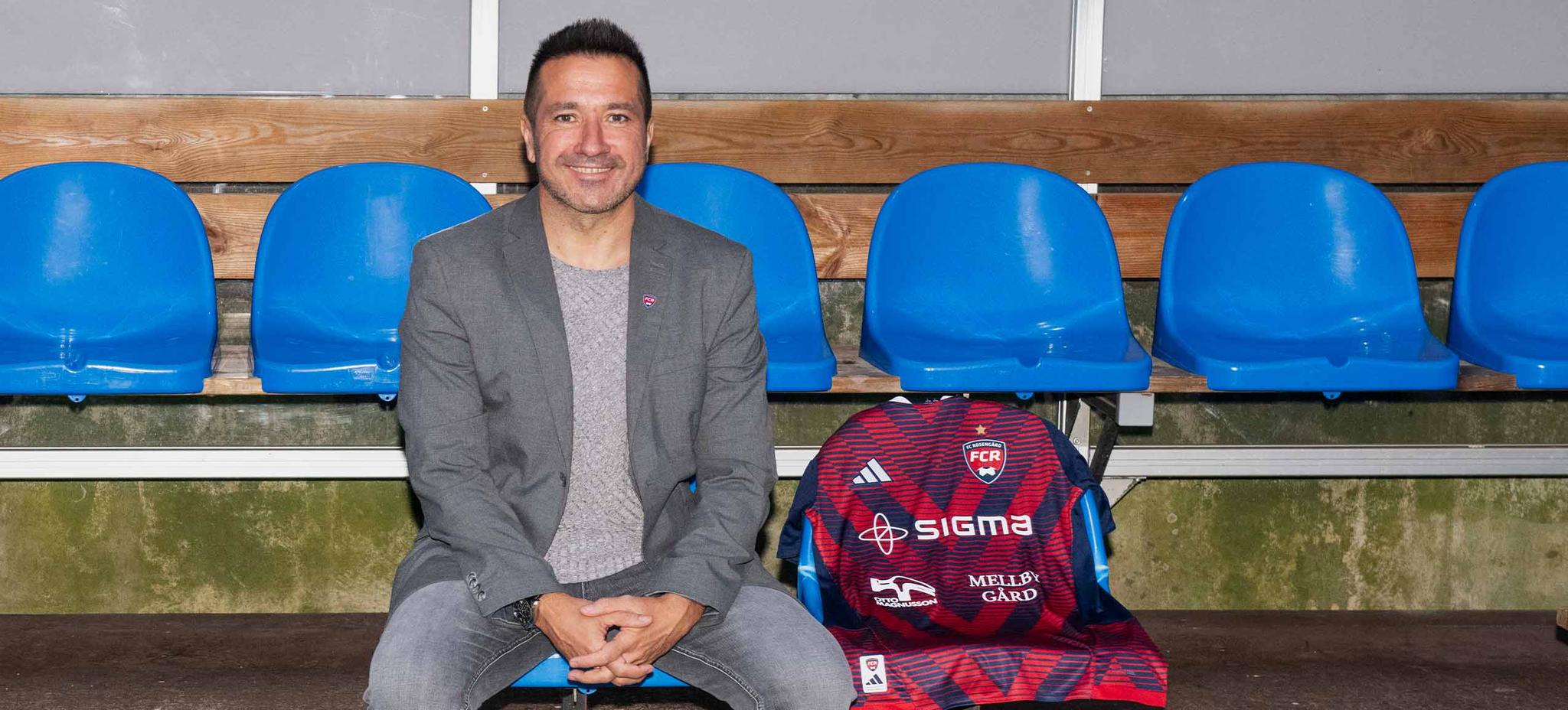
Fran Alonso has worked in five countries, won titles with Celtic and developed young players on both the women's and men's sides. Now he takes over FC Rosengård in a vulnerable position – with a clear first goal, but also a strong belief in the club's long-term potential.
– If you work in women's football, you know Rosengård. This has always been one of the top clubs. For me, it is an honor to be here, says Fran Alonso.
The new head coach comes to Malmö with broad and international experience. Since 2014, he has primarily worked in women's football, but his coaching background also includes several years in English men's football.
He has worked in England, Scotland, Spain and the USA, among other places. Now a new country, a new league and an FC Rosengård that is far from the position the club has historically been used to await him.
At the same time, it is precisely the opportunity to build something new that attracts him.
– We are in a position where we don’t want to be in. But for me, the important thing is the potential to get where we want to be. The fundamentals are good, both on and off the pitch, and I really want to be part of this rebuilding.
– I really believe that the club will get back to where it should be – and fight for titles.
Inspired by the journey with Celtic
One of the experiences Alonso highlights in particular is his time at Celtic. When he joined the club, the women’s team had a relatively small audience. Four years later, 17,000 spectators watched his last home game at Celtic Park.
For him, it became an example of what can happen when sporting development, identity and commitment around the team grow together.
– When you do what you love and it means a lot to the people around you, it becomes very special. The community and supporters at Celtic were incredibly passionate.
He sees parallels to the opportunity at FC Rosengård.
– Rosengård has been at the highest level but has had a couple of tough years. The club can come back and once again become a role model and a top club. I don't know exactly how quickly it will go, but the stronger the foundations we build, the greater the chance we have of creating long-term success.
The club's history is an important part of its appeal.
- I remember Marta and Caroline Seger in this shirt, two legends in the sport. The fact that I am here now feels very big.
The first goal is clear
Although the ambitions in the long term are high, Alonso is clear about what the mission is about here and now.
- We will not hide. The goal this season is simply to stay in the league.
He takes over a young team that has shown great potential at times during the season, but has also had difficulty controlling matches over 90 minutes.
Alonso points out, among other things, that a large proportion of the goals conceded have come in the final quarter of the matches.
- Approximately 30 percent of the goals have come in the last 15 minutes. The team has a good foundation and is skilled with the ball. Decision-making in crucial situations has not been good enough in some cases. But that is also natural in a very young squad.
He describes the group of players as talented and capable of development, but also emphasizes the importance of cohesion.
– The only question I had before I arrived was how the dressing room worked. Everyone I have spoken to has said that it is a fantastic and very close-knit group. When those parts are in place, I believe that we can develop and achieve our goal.
“Culture first – then game model”
A central part of Alonso’s leadership is summarized by the formulation: culture first, then game model.
For him, order is crucial.
– I have experienced many failures in my career, but also success and titles with teams that had never won before. What I have learned is that there is an order that cannot be changed.
Values and demands comes first.
– We should have a number of values that are non-negotiable. They apply when we win and when we lose. We should live by them every day, and they should be linked to hard work and commitment.
Then come the relationships within the team.
– You have to get to know the person before you get to know the player. What worries them? What motivates them? How can I help them, both inside and outside of football?
– When relationships work, you get a team that is about “we” instead of “me”. A team where the players are prepared to do everything for the person on the right and the person on the left.
Only when the values, demands and relationships are in place does the work on the actual game model begin.
– When we have managed to do things in that order, the end result has been success.
Clear roles more important than numbers
In the short term, Alonso wants to avoid changing too much at once. Instead, he wants to create clarity and security.
– When a team hasn't won in a while, confidence can start to drop, especially in a young squad. Now it's about changing as little as possible while creating the greatest possible effect.
He will continue to work with the existing management team, who will remain at the club.
– There is a very good group of coaches here and I am happy that everyone is staying. Their feedback will be important.
According to Alonso, formations are less important than the players' understanding of their roles.
– It doesn't matter that much whether you play 4–4–2, 4–3–3 or with three central defenders. The important thing is that the players know exactly what to do.
Young players should be allowed to make mistakes
FC Rosengård has no fewer than eight players in the A-team who have gone through our own youth system. Creating a clear path from the youth system to the senior team is also an important part of Alonso's coaching philosophy.
He highlights his experiences from Southampton, where the club built its business on smart recruitment and development of its own players for many years.
– We sold our best players every year, but every year someone new came through the academy.
He mentions players from Southampton's youth academy such as Adam Lallana, Luke Shaw, James Ward-Prowse and Gareth Bale.
Alonso has later brought the same principles to women's football.
- I learned how to give young players a chance, how not to give them too much too soon and how not to be too hard on them.
According to him, mistakes are a natural part of development.
- If you give a young player a chance and she makes a mistake and then you punish her and decide she is not good enough - then you are doing wrong. Mistakes are part of development. It is a risk you have to be prepared to take.
At the same time, no place should be given away for free.
- Opportunities have to be earned.
During his time at Deportivo, Alonso used more academy players and gave more players first-team debuts than any other coach in the club's history.
- It is a great source of pride for me. The young players often come from the city, have loved the club since they were little and know what it means to play for the city team. They often play with enormous heart for the team.
The fans should see a brave and aggressive team
Alonso hopes that some changes will be visible immediately.
– Hopefully, from the first match you will see the intensity, the reaction when we lose the ball, the aggressiveness and the pride in wearing the shirt.
The effort should always be total.
– If someone finishes the match and still has 10 percent left in their tank, it is not good enough. The tank should be empty.
The longer-term work on the game will take longer, but even there the direction is clear.
Alonso wants to see a team that presses high, dares to play through the pressure of the opponents and uses the transition game more.
– I want the fans to recognize the team as very aggressive and very brave. We will press high, play with courage and be electric when the opportunity arises.
He especially sees an opportunity for development in the counter-attacking game.
– Sometimes it is right to win the ball and play a safe pass. But sometimes it's best to attack a disorganised defence with two passes.
– Quick changes are exciting for the fans and can create more chances.
The long-term vision is clear.
- I want us to be an electric team: brave, aggressive, a team that tries to dominate games and hopefully score a lot of goals.
Setbacks will be fuel
Alonso's view of leadership has also been shaped by some of the most painful moments of his career.
In his last full season at Celtic, the team looked to be champions. In the 90th minute, the title was theirs, but a dramatic finish in another game changed everything.
- We went from basically winning the league and almost touching the title, to losing it. Then we thought we had won it again, before we lost it again. It was absolutely heartbreaking.
A week later, the cup final against Rangers awaited.
– My speech before the match was about the time for revenge.
Celtic won the final 2–0.
– We decided that we would not leave the season empty-handed. The loss became fuel.
The following season, a few months after Alonso had left the club, Celtic won their first league title – incredibly, through a goal in the very last minute.
– The players called me. I was no longer there, but I celebrated as if I had been there.
For Alonso, the story sums up one of the most important tasks of leadership.
– The biggest lessons are often found in the biggest defeats. It is about how to take very difficult moments and turn them into lessons that make you grow.
That is also the strength he now wants to bring to FC Rosengård.
A team in the lower part of the table right now - but with the history, talent and potential to build something strong again.
– I am very proud to try to help and be a part of it.